Producers
-
Description:
One hundred and thirty years after its founding, the story at Gunderloch, one of the Rheinhessen's most revered estates, is evolving. The changes happening here are cause for real excitement, and all of them are springing from the restless mind of Johannes Hasselbach, the master and commander of the estate since 2016. He is taking Gunderloch in a new direction, and the resulting wines are achieving levels of grace, balance, and natural energy they have never seen before.
Gunderloch is a thriving estate of approximately thirty-one hectares of vines in some of the top vineyards of the "Roter Hang" ("red slope") area in the Rheinhessen appellation. In Nackenheim they own the dominant portion of the grand cru Rothenberg (sixty-five percent of the estate’s holdings) which is planted completely to Riesling. Their GG from here is the flagship of the estate; their noble sweets from the site are legendary. The other part of their production comes from five kilometers down the road in Nierstein, where they work steep parcels of vineyards whose names resound to the ears of German wine lovers: Niersteiner Pettenthal and Niersteiner Hipping, which both provide GG wines for them. The average yield is held to forty-five hectoliters per hectare, among the lowest in Germany, resulting in wines of high extraction and great quality. Minimum ripeness for the various quality levels is significantly above the requirements of the German wine law. The wines are never de-acidified and in high acid vintages bottling is often delayed to allow the wines to harmonize and soften. The cellar work is accomplished with a minimum amount of handling and has traditionally been reductive in style—although that is now changing as Johannes pursues his explorations in winemaking. After much experimentation and rethinking of received wisdoms, Johannes is making signifcant changes at Gunderloch. To wit:
- Less handling of the wines and less “winemaking” overall in favor of hard work in the vineyards. This can be called his guiding philosophy.
- The previously all-reductive cellar is now seeing more barrels, longer maturations, and more skin contact on the wines. This is having a profound impact on the house style.
- Spontaneous fermentations are now the norm; all the estate wines are fermented with native yeasts. Johannes is also doing groundbreaking work starting his fermentations in the vineyards before bringing the wines into the cellar. His experimental wine called VIRGO is entirely fermented by vineyard yeast started outside during harvest.
- The estate has been practicing organic for five years. Johannes started the certification process in 2020. He has also become one of the "young guns" leading the charge for studying and promoting chemical-free viticulture at the VDP.
- The wines at Gunderloch have all been VEGAN since the 2017 vintage.
- The wines are getting drier, more focused, more mineral. Lowering his alcohol levels on the dry wines is a priority for him--and a challenge, given the warming climate and placement of his vineyards. His residual sugars across the board are starting to skew lower as well, which of course reflects the general trend in German winemaking.
In sum, Johannes is actively directing his steps forward at Gunderloch, not passively staying with past practices or assumptions. He feels that with changes to the ecology and culture around him, this is not only a good idea but crucial to the success of his family's estate.
Meanwhile, the Rieslings here, particularly those from the Rothenberg, remain among the finest and most important in the Rheinhessen and in Germany. Taste them and it is obvious why: these are rich, elegant wines full of yellow fruits, great structure and fine acidity for long aging. But it is their newfound balance and the intrinsic energy within them--a direct reflection of their winemaker's youth, vitality and new ideas--that we find so compelling.
BOWLER E-Zine Issue 1 | Q4 2020: Learning and Relearning German Wine
Image: Region:
 -
Description:
"We're getting the band back together!" was how I felt asking Stefan Steinmetz to join the Bowler national portfolio this year. From 2005 to 2012, the Steinmetz wines were a key member of the influential and wonderful Mosel Wine Merchants portfolio, which first brought fame and attention to shining lights like Clemens Busch, Immich-Batterieberg, Matthias Knebel, Peter Lauer and others. I've followed and enjoyed drinking the Steinmetz wines since then, but never thought I would have the honor of representing them at Bowler. Fortunately, life is long and luck favors the prepared, so here we are.
Weingut Günther Steinmetz consists of 13ha of vines spread over a rather broad area of 20km in the heart of the Middle Mosel. The historic estate, centered in Brauneberg, is 120+ years old; Stefan's grandfather was one of the first in the village to bottle wines under his own name. The vineyards on the elegant, blue-white-and gold labels read like a who's who of legendary Mosel sites: Brauneberger Juffer, Piesporter Goldtröpfchen, Wehlener Sonnenuhr, Dhroner Hofberg, Mülheimer Sonnenlay, and Kestener Paulinshofberg, all ranked as VDP Grosse Lagen (Grand Cru's). Perhaps the most exciting and defining of Stefan's holdings are his sites in Wintrich, the Wintricher Gaierslay and Ohligsberg, two steep, south-facing, cool and breezy side-valleys of purple-hued slate and quartzite in which he holds commanding positions. There is a sense of breathing sacred air as one strolls through these quiet, half-hidden vineyards.
Stefan took over the winery when he was just 17 years old due to the sudden passing of his father in 1998. Not hoped for and not easy, it took a heroic level of determination to assume the mantle at such an important estate. His success and expansion of it in subsequent years has been remarkable. Today, his wines are considered a benchmark for the area, lauded by collectors and required reading in every major vintage report.
Farming and winemaking here are strictly conscientious. Grapes are harvested in low quantities, entirely by hand. As Stefan puts it: "The external economy is oriented towards natural viticulture, which includes the most environmentally friendly viticulture possible by not using fertilizers or herbicides and insecticides. In the cellar management, we renounce any addition of treatment agents such as yeasts and fining agents, as well as acid additives or deacidification limes. Also, no animal proteins are used. All wines, without exception, are fermented spontaneously in large wood or steel. The aim of my efforts is to create wines that are a "fingerprint" of everything that makes up the character of a great vineyard."
Stefan makes a full range of Rieslings from dry to sweet, all connected by throughlines of grace, harmony, and crystal-clear mineral expression. Those who like tension in their wines will not be disappointed. Also notable are his Pinots which come from a mix of German and French clones grown on slate. He vinifies these exclusively in neutral oak with varied levels of stem inclusion and maceration, depending on the site and vintage. He also experiments with other red grapes, including a particularly compelling Syrah. There are even a few Romanée-Conti barrels in the basement (don't ask, don't tell).
How can I express in a few sentences the special nature of this small but crucial family estate, its soul-gladdening wines and its kind-hearted, dedicated owners, Stefan and Sammie Steinmetz? I cannot. The wines will have to do that for me. I look forward to sharing them with everyone and helping this estate achieve even greater status and appreciation than it has already earned.
Image: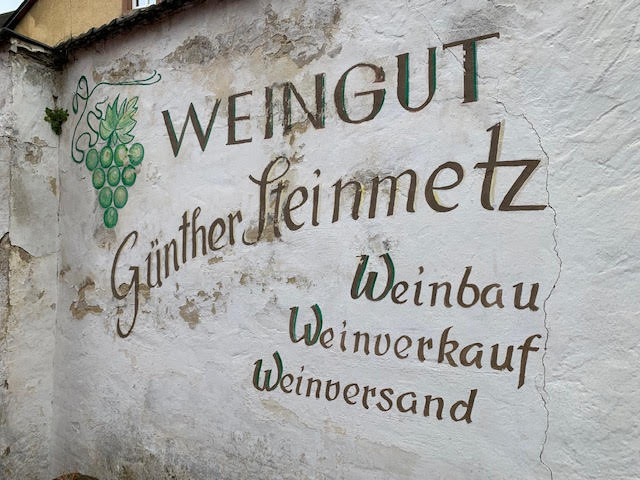 Region:
 -
Description:
Halarà (Χαλάρα) is Greek for "take it easy."
Stefano Amerighi
Francesco de Franco ('A Vita)
Nino Barraco (Barraco)
Corrado Dottori (La Distesa)
Giovanni Scarfone (Bonavita)
Francesco Ferreri (Tanca Nica)Six close friends, a who's who in the Italian natural (but territory-driven and clean) wine world. Their families have been vacationing together for years. Then they had the opportunity to buy a vineyard together, one that was going to be ripped out, the planting rights of which would probably have been sold to someone for a new vineyard in northern Italy. So they saved this vineyard, in Contrada Abbadessa in Marsala, which is planted ad alberello to roughly 80% Parpato and 20% Catarratto, 40-year-old vines. Parpato, also called Quattro Rappe, is one of those forgotten grapes...it was thought to be a local biotype of Grenache but it seems now is more similar to Carignan. Anyway, it's adapted to this territory over the centuries and behaves like itself.
The project is about this vineyard, a celebration of Mediterranean-ness. Marsala is essentially the dead-center point of the Mediterranean. Halarà is also about a spirit of collaboration between six winemakers with their own estates to run, spread between Sicily, Pantelleria, Calabria, Tuscany, and Le Marche.
Though the vineyard is in Marsala (the place), they are not making Marsala (the wine). For now, three wines...a rosato, a rosso, and, eventually-con calma-halarà, a bianco. Fresh, energetic, and belying the hot, arid climate of Western Sicily.
2019 was their first vintage.
"What is the Mediterranean? A thousand things together. Not a landscape, but innumerable landscapes. Not a sea, but a succession of seas. Not a civilization, but a series of cilivizations stacked upon one another." -Fernand Braudel
Image: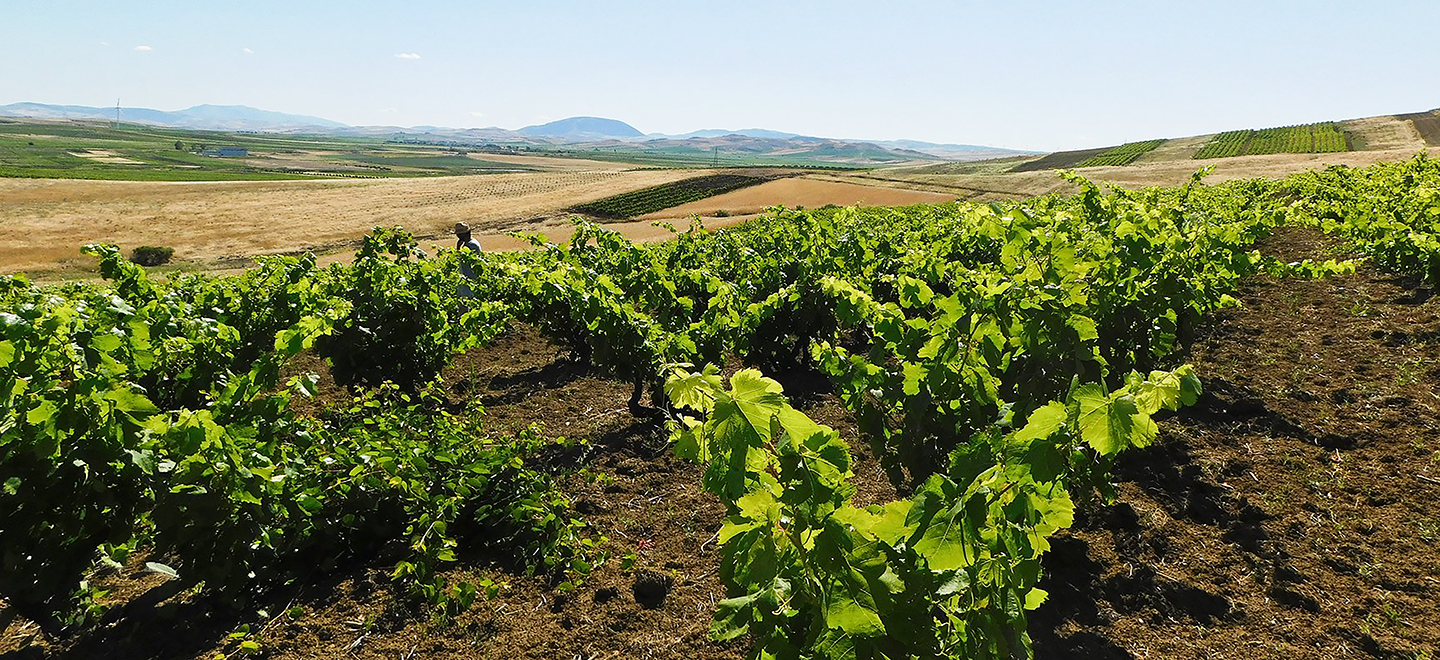 Region:
 -
Description:
Herve Villemade has family roots in Cellettes, a small town in the Loire Valley of France, going back multiple generations. Since taking over in 1995, he has grown his estate to include the original 8.5ha owned by his parents, an additional 8ha that he has purchased over the years, and the difference being parcels that he rents. At the beginning, the vines were farmed conventionally (as that is they way his parents farmed) using herbicides and fungicides, and the wines were made the same way with lab yeasts and additives.
It wasn’t until a few years later that he tasted wines made by Marcel Lapierre in Beaujolais and Thierry Puzelat at Clos du Tue-Bouef in nearby Les Montils that his eyes were opened. Herve immediately began experimenting with zero-sulfur winemaking, but quickly realized that in order to do this, he would need higher quality fruit. This realization led him to begin the arduous task of converting entirely to organic farming starting in 2000 and ultimately shaping the domaine as we know it today.
Image: Region:
 -
Description:
Christoph Hoch is the twelth generation, since 1640, to make wine in his town of Hollenburg, on the south side of the Danube. Historically, vines were planted on this side of the Danube and the north side was for food crops. In 2013, Hoch split from his parents winery, starting with five hectares that would have been his inheritence eventually. Today Hoch has 12 hectares total, all in Hollenburg, and all farmed biodynamically and certified by Demeter. The subsoil is Hollenburger conglomerate, which was formed by the Traisental and Danube rivers crashing together and compacting the chalk with the river stones. The chalk is equally as active as the Côte des Blancs in Champagne, bringing minerals to the vines. This similarity in soil inspired Christoph to make sparkling wine, although, the source of chalk is completely different. In Hollenburg it's from the Alps and in Champagne it's maritime chalk, or what is called muschelkalk in German.
Christoph has mostly Grüner Veltliner planted, along with Riesling, Zweigelt, Weissburgunder, Blauer Portugesier, and Muskat Ottonel. Hoch's still wines are always a blend of three vintages and the sparkling wines are two vintages. Generally, for the still wines, the most recent vintage is 30% of the blend, 50% is from two vintages ago, and 20% is three years old. This gives a completely different perspective on terroir. Naturally, wines from some areas are more structured or tannic and they benefit the blend by having time to mellow a bit. The youngest wine is normally the fruitiest and approachable. It's a completely unique way of highlighting the Hollenburger conglomerate soil over vintage. The Hoch wines are very original and are some of the best representations of the ‘new’ wines of Austria.
BOWLER E-Zine Issue 1 | Q4 2020: Austria - Two Newbies from Hoch
BOWLER E-Zine Issue 4 | January 2022: Compost Cookery with Foradori, Hoch, Bucklin, and Podere Giardino
Image: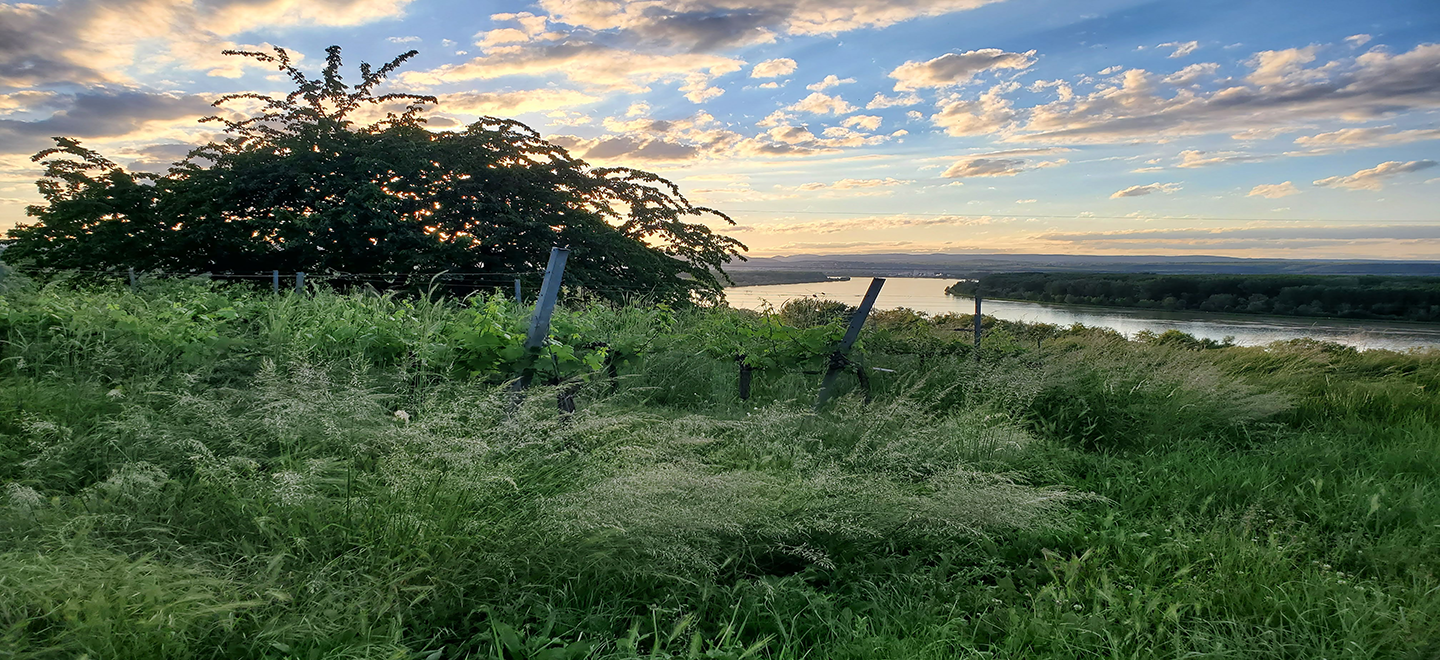 Region:
 -
Description:
Julie Hoch, a German native, transplanted herself to Austria after getting bitten by the wine bug and falling in love with Christoph Hoch. Julie is a phenomenal cook, constantly coming up with new fermented hot sauces or special pickle recipes that you won’t find in any cookbook. Saying that she is a great cook, doesn’t quite capture the extra creativity that goes into each dish she prepares. So, it is not a surprise that she dreamed up a new low ABV drink combining wine and botanical tea.
She was inspired because there are so many flowers and plants growing naturally among the Hoch vineyards and she wanted to create something that captured the smells and surroundings of the vines, another level of terroir. There are wild elderflower bushes and wild rose bushes all throughout their biodynamic vineyards in the Kremstal. In the spring and summer, she harvests the petals by hand and dries them.
To make this naturally low ABV sparkling botanical wine, Julie starts by making a tea during harvest, with the pure petals of the flowers. When the grapes come in, she blends the tea with the fresh grape must, about 70% grape must to 30% tea, and captures the natural fermentation in the bottle. The sparkling botanical wine finishes fermentation dry and naturally has 7% ABV. The floral notes are present, but beautifully integrated, with the juicy aspects of the Grüner and Zweigelt fruit. The wines are complex, but not complicated – fresh, dry, floral, truly delicious and of course, unique like all of Julie’s creations.
Image: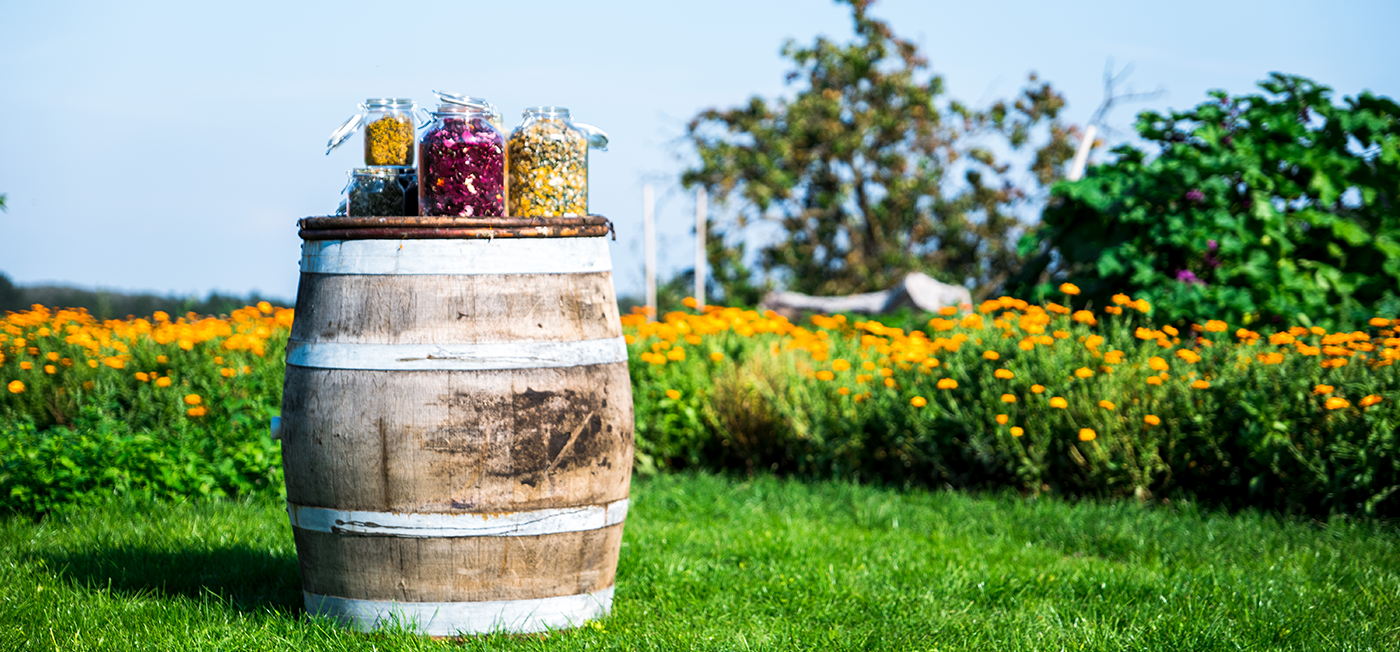 Region:
 -
Description:
Hugo Mendes originally trained as a biomedical engineer, but in 2004 he worked his first wine harvest and decided to entirely change his career. He became a winemaker, and for 11 years worked in cellars and consulted all over Portugal. In 2016 however, tired of making wines to other people’s specifications, he decided to strike out on his own. The only problem is that he didn’t have any money.
He got a good deal on some friend’s grapes, made the wine in a friend’s winery, and pre-sold as much wine as he could over social media just so he could afford to bottle it. Since that first vintage, however, Hugo has skyrocketed to the heights of Portuguese wine culture. He has become well known for his efforts to help build up a new, younger, more dynamic Portuguese wine community and the endless creativity of his wine making.
In many ways, however, Hugo is also very traditional, working almost entirely with the indigenous grapes of the region (something that is particularly rare in Lisboa), and working to preserve the region’s natural freshness in his wines, as opposed to trying to pump up the alcohol or smother their natural flavors in fancy cooperage. Hugo is now based in Alenquer, just north of Lisbon along the Tagus river. Here, about 40km east of the Atlantic, the climate becomes slightly more Mediterranean, with warmer days and less humidity, yet still with the region’s characteristic chalky/clay soils. He uses the climate to his advantage, making wines of juicy verve that are at once the archetypal expression of Lisboa yet also totally crushable.
This profile and tasting notes were edited from the GK Selections website, along with the pictures used. For more information please visit GK Selections.
Image: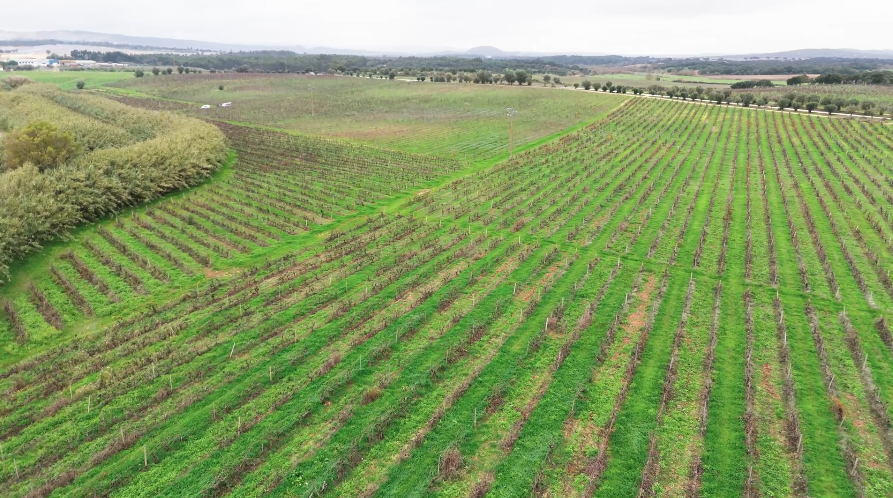 Region:
 -
Description:
Champagne Hugues Godmé is a small grower located in the Grand Cru village, Verzenay, in the northern Montagne de Reims. Started by Hugues Godmé and his daughter Lucille Godmé They own a total of seven and a half hectares that cover four villages in the north and east of the Grand Montagne and west in the Petite Montagne. Overall, the winery has three hectares of Chardonnay, 2.80 hectares of Pinot Noir and 1.80 hectares of Meunier. Their vines average 30 years-old and the oldest are more than 60 years-old.
The Godmé family have been vignerons since the 19th century. Hugues’ grandfather, Joseph, began bottling after WWII and his father followed suit. Hugues received his first vineyard in 1976, a gift upon his graduation from viticulture school. All of this to say, Hugues broke generations of tradition when he made the decision to change the way the family vineyards were farmed. In 2006 he began to farm organically, becoming certified organic in 2013. Biodynamic certification came the following year in 2014. Since making the change to biodynamic farming, the vineyards are healthier and more resistant to disease and Godmé is now part of the biodynamic winegrowers association, Biodyvin. Today, Hugues’ daughter, Lucille, continues her father’s commitment to farming practices that enrich both the wines and the land on which they grow.
In the cellar, they work with spontaneous fermentations in neutral oak and enamel-lined cement tanks. They move juice by gravity to retain fresh aromas and each parcel is vinified separately to respect each terroir. The top wines are vinified directly in the barrel. Malolactic fermentation happens sometimes and there are no efforts to stop or encourage it. The second fermentation happens in their cellar carved out of chalk right below one of their vineyards in Verzenay.
Nowhere is the benefit of healthy vines more evident than Godmé’s collection of single-vineyard cuveés. Vinified in a minimalist fashion, with no dosage, the aim is to highlight the individual character of each vineyard. The wines are extremely limited, but they promise great reward to anyone wise enough to seek them out.
Image: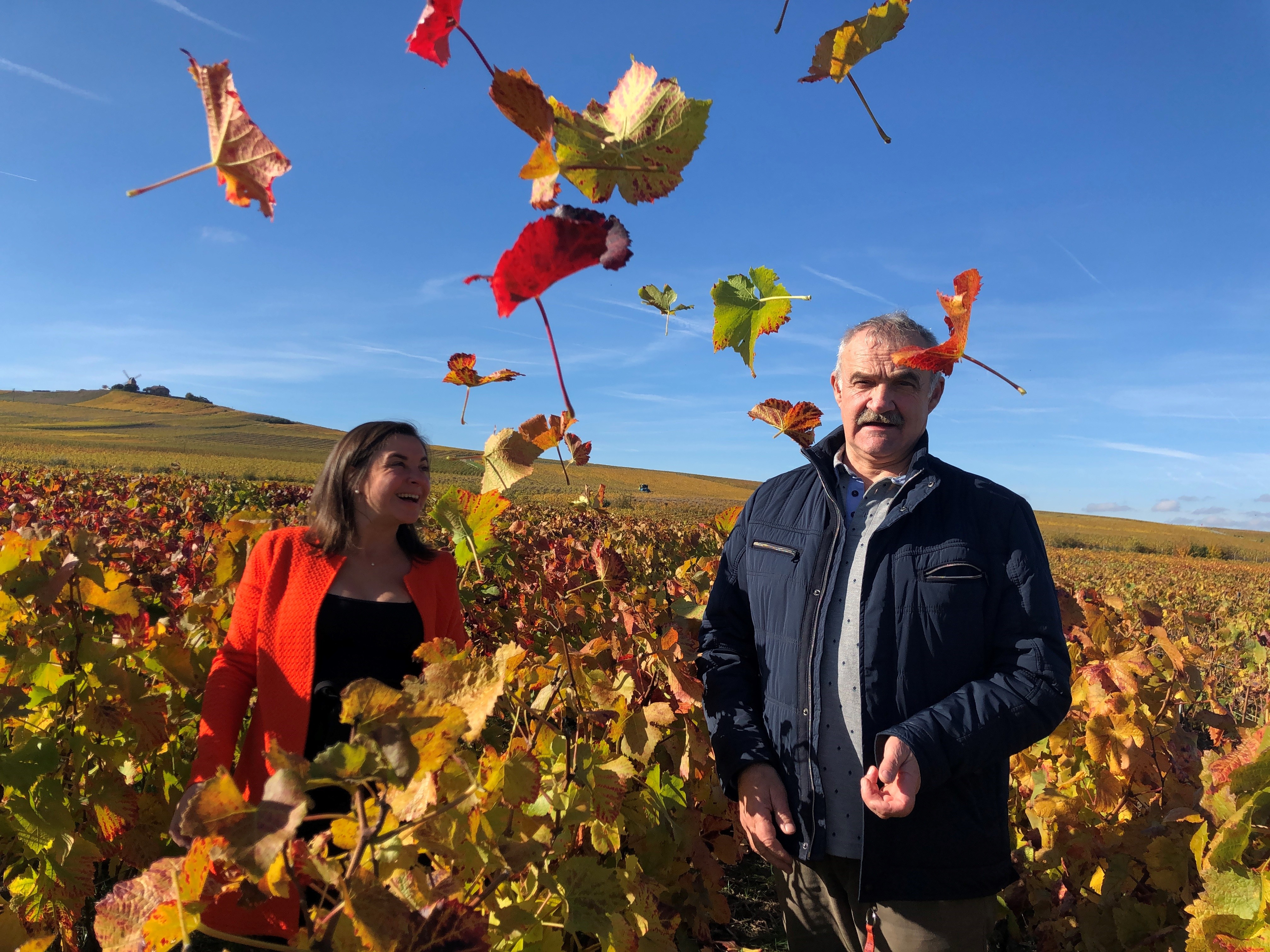 Region:
 -
Description:
Every now and then a revelation comes across the table, even in an area like Chianti that is bursting with amazing wine. Susanna Grassi at I Fabbri is making wines that are at once rustic and poised, with incredible structure and balanced freshness. In short, these are the Chiantis we like to drink.
The land at I Fabbri has been in Susanna Grassi’s family since the 1600s; they were winemakers, and also blacksmiths. They owned a workshop located in the ancient village overlooking the farm that has been used for many years for agricultural activity. This is where the name of this town and of the company originates. In the 1920s, Susanna's great grandfather Olinto began bottling and selling the wine commercially. In 2000 Susanna returned from a career in fashion working in Brussels and created the I Fabbri estate and revitalized the vineyards. Gradually she converted everything to organic and the estate is now certified.
From I Fabbri, “The territory of Casole, in the Lamole – Greve in the Chianti area, is a large sunny basin that is characterized by an altitude difference that fluctuates between 450 and 650 meters above sea level. The soils are mostly sandy: they are loose soils, which derive from a millennial breakdown of sandstone rocks, which are not very compact and very permeable - poor in terms of organic substances. The strong temperature changes, the southern exposure of the vineyards and the composition of the soil give the wines of I Fabbri and in particular its Sangiovese unique and recognizable organoleptic characteristics.”
Image: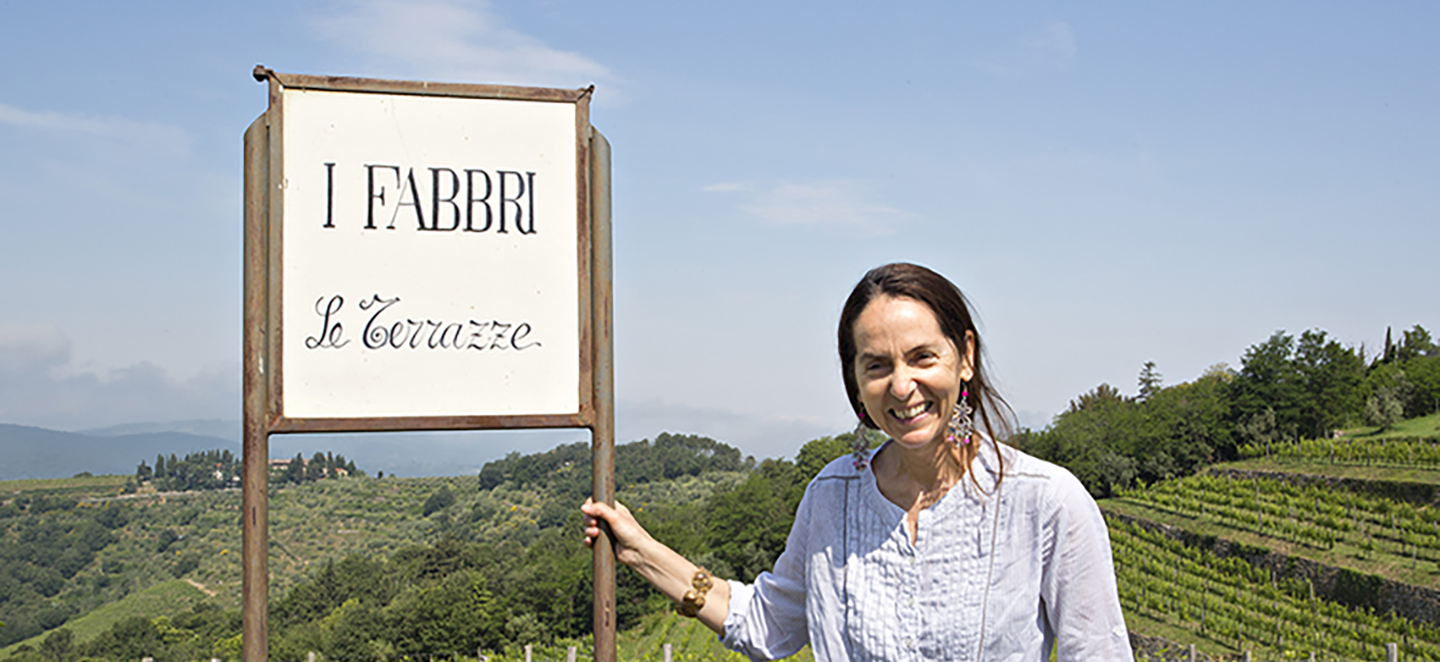 Region:
 -
Description:
We are very excited to be working with Gernot Kollmann, one of the most watched winemakers in Germany. After working at Van Volxem and then making the Knebel wines in 2008, Gernot had the opportunity (with partners) to purchase the historic estate of Immich-Batterieberg.
The Immich family history in the Mosel dates back to the Middle Ages, when a Prince von Esch possessed the 12th-century building. Located in the center of Enkirch, the original section of the castle, Escheburg, is named after him. The Immich family would own the estate for over 500 years (1425–1989). In the mid-19th century, Carl August Immich needed more cultivable land on which to plant vines. His holdings included the Enkirch hillside, which was less a hillside and more a steep cliff face of solid stone; using sprengbatterien (a battery of explosives filled with gunpowder) from 1841 to 1845, he reduced the site to rubble, which not only made it cultivable but also gave the vineyard its name, Batterieberg (“demolition hill”). The estate's name refers to this site.
The estate consists of 15 ha. Holdings include 1.1 ha of the best parcels in the Batterieberg (grand cru in grey slate + quartzit), as well as parcels in the great vineyards of Ellergrub (grand cru in blue slate), Steffensberg (1er cru in red slate) and Zeppwingert (grand cru in grey slate + quartzit). All of these sites contain parcels of very old, ungrafted, pre-phylloxera vines--a genuine treasure trove of vine material almost unknown elsewhere in Germany. The Escheburg is a dry Riesling, firm and impressive, made from a blend of ungrafted vines from Steffensberg, Ellergrub and Batterieberg. It represents an astonishing value. Batterieberg is located within the larger Zeppwingert, which along with Ellergrub and Steffensberg were among the highest-ranked vineyards according to the 1897 Mosel-Weinbau-Karte, the Prussian viticultural tax map of the Mosel. Gernot's most recent acquisition in 2014 was a small, dizzyingly steep site in neighboring Traben called the Zollturm ("toll tower") which he uses partly for his Sekt and partly for a grand cru cuvee named for the site. The wines are all produced dry in a combination of used casks and stainless steel with full fermentations, ambient yeasts and nothing added to the wines except a low amount of sulfur. The wines are therefore natural and vegan. They are also compellingly vibrant, long-lived in the cellar, and most profoundly terroir-driven.
Immich-Batterieberg has been practicing organic viticulture for ten years and certified for the first time in 2022.
Image: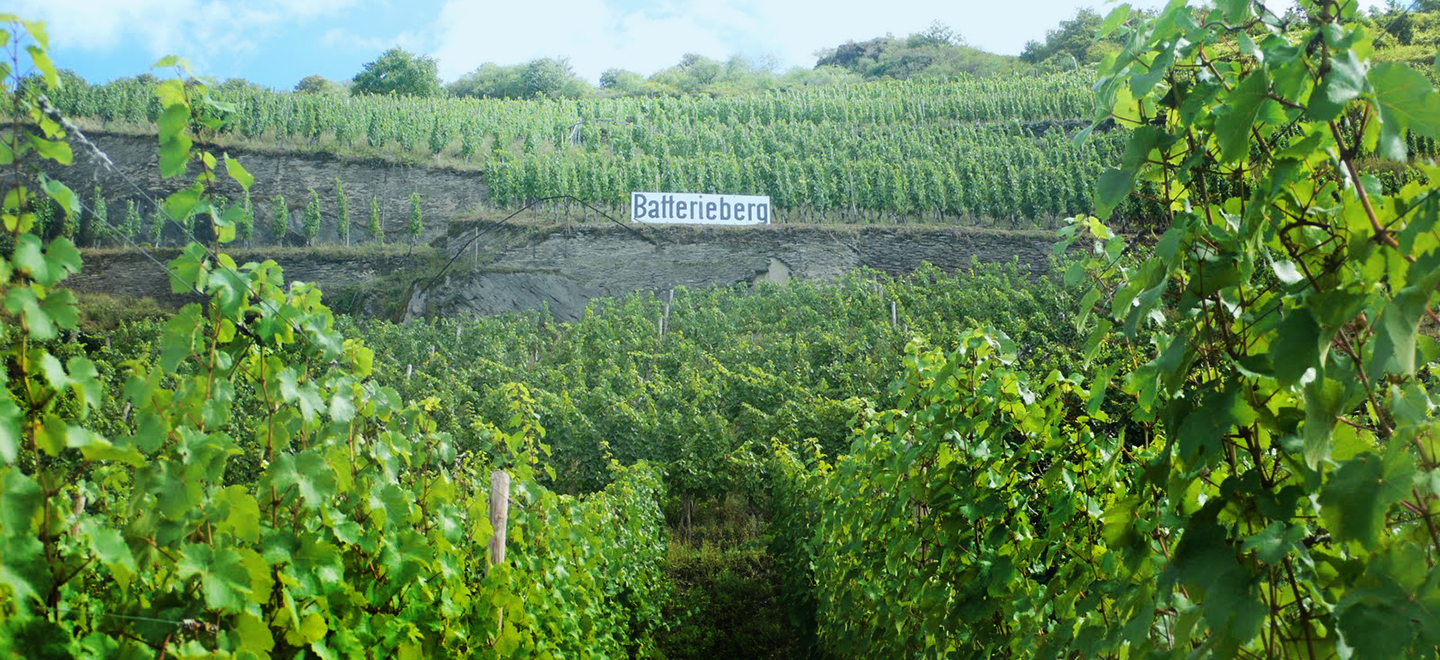 Region: