Podere Sottoilnoce
- Emilia-Romagna, Italy

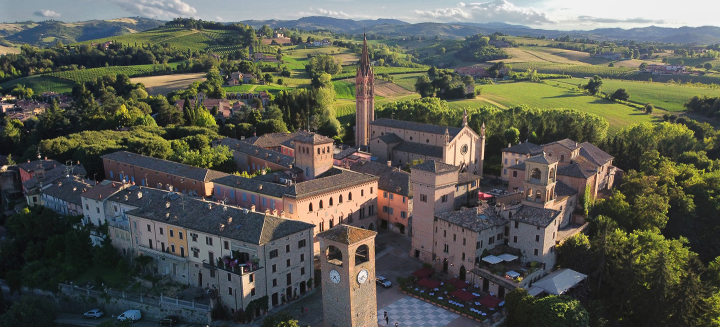


Max Brondolo has been directing the wine in his veins and dreams in his mind into the roots of his young estate, Podere Sottoilnoce, located in the town of Castelvetro di Modena.
Originally from Milan, his grandparents were Emilian on one side and Piedmontese on the other. The nonni from Piedmont had vineyards in Belveglio d’Asti, in the hamlet of Brondoli, where his grandfather grew Barbera, Grignolino, and Moscato. Max’s childhood memories are tied to summers on the farm: the barn, the animals, stealing grapes from the vineyard, the harvest. His father would open Beaujolais Nouveau in mid-November and Bordeaux at dinners with colleagues; but at family lunches, the wine was always the grandfather’s, with hand-written labels. Max spent his first paychecks on wine, and wine became his consuming passion. This imprint stayed with him through a career as a business entrepreneur. Then came the U-turn. At age 40, he married his wife, Stefania, and life took them to the countryside of Modena, which they felt was better suited to raising a family than Milan.
Modena has given us significant emblems of Italian culture: balsamic vinegar, Ferrari, Maserati, Luciano Pavarotti. And Lambrusco. Lambrusco…wonderful, diverse, convivial, supremely food-friendly—and, lest we forget, one of the most successful exports ever from Italy to the United States. One brand alone hit 11.5 million cases sold in a year, a record that still stands as the highest sales for an imported wine in U.S. history. Dollar signs replaced pupils in eyeballs, a behemoth was unleashed, and a wine with hundreds of years of history was reduced to a commodity. "Italian Coca-Cola!" So it goes sometimes.
Max arrived in Castelvetro di Modena with a long-standing desire to make wine, but he was also deeply pessimistic. In his mind, two-Euro wines on the bottom shelves of supermarkets were what defined the area. Luckily, he quickly encountered the wines of Vittorio Graziano, Gianluca Bergianti (Terrevive), and Claudio Plessi. A whole world opened for him. He was surprised to discover the enormous diversity of the area's grape varieties and considered a strategic opportunity: an area with so many varieties capable of producing high-quality wines, yet with such a low profile, was unheard of in Italy. This was coupled with a name that—even if associated with low quality—needed no explanation: everyone knows what Lambrusco is, it's a sparkling red wine. It "just" needed to tell its true story through traditional, clean winemaking methods, carried out using natural agriculture, and distancing itself as far as possible from industrial winemaking (autoclave).
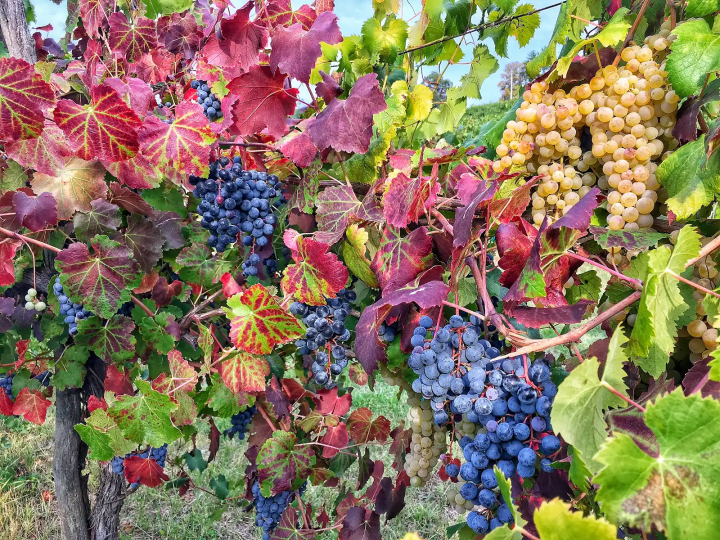
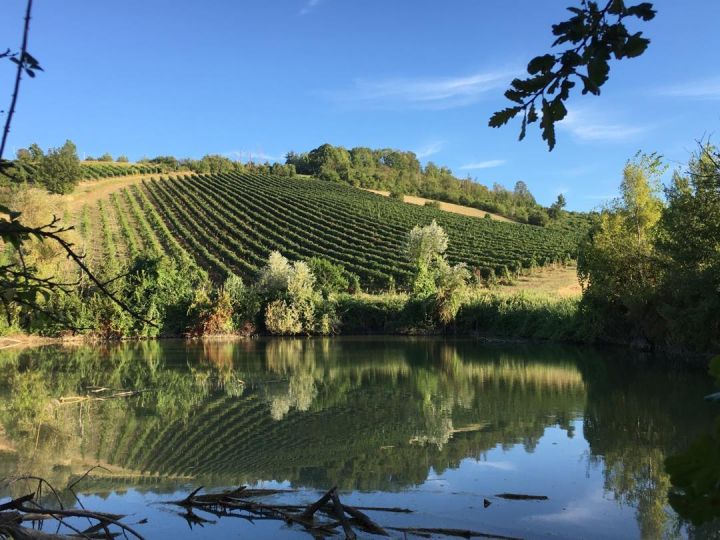
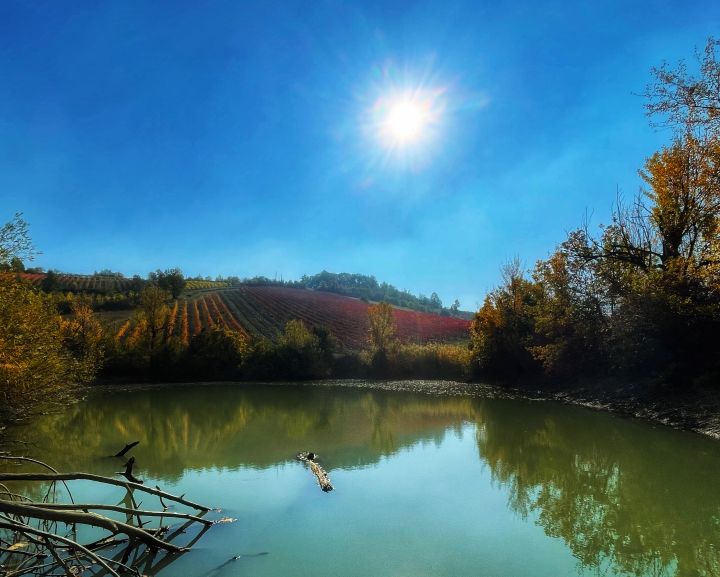
In 2016, he found a young one-hectare vineyard of Lambrusco Grasparossa for sale. In the middle of it all, a gigantic walnut tree. He fell in love with the place. Podere Sottoilnoce—the farm “under the walnut tree”—released its first vintage in 2017. Today, there are 6.5 hectares of vineyards among an additional 7.5 hectares of woods and meadows, all conducted in biodynamics. There are the white grapes Trebbiano Modenese and Trebbiano di Spagna, classically the backbone of balsamic vinegar. There are many different biotypes from the loosely-related Lambrusco family—some familiar like Lambrusco Grasparossa or Lambrusco di Sorbara, others like Lambrusco del Pellegrino time-warping in from the Renaissance. And then there is everyone’s new favorite, the rainbow-colored Uva Tosca, impervious to artificial intelligence. The wines are vinified dry and then undergo secondary fermentation in bottle around February/March under a waxing moon, triggered by the sole addition of grape must. They are undisgorged and kept under crown cap. The striking labels are the work of artist Denis Riva. Some of them are original pieces and were not specifically drawn for Sottoilnoce, while Cattabrega and Trifalco are Denis’ visual response to drinking the corresponding wines.
What’s old sometimes becomes new. Even better is when the thing coming around feels not nostalgic, but contemporary. Sometimes it takes an outsider-dreamer to be a conduit. Max helped develop a collective called ‘Modena: The Frizzante Revolution,’ nine like-minded organic/biodynamic growers in Modena, the cradle of naturally-fermented wines. They have done trade events in Toyko, Copenhagen, and New York.
There is so much more that can be said about the fun, delicious (but also true and real and kaleidoscopic) world of Emilia frizzanti rifermentati. The best way to hear the story is to jump off this page, gather good friends, good food, and many bottles. And the revolution, mostly untelevised, will quietly crackle on.